
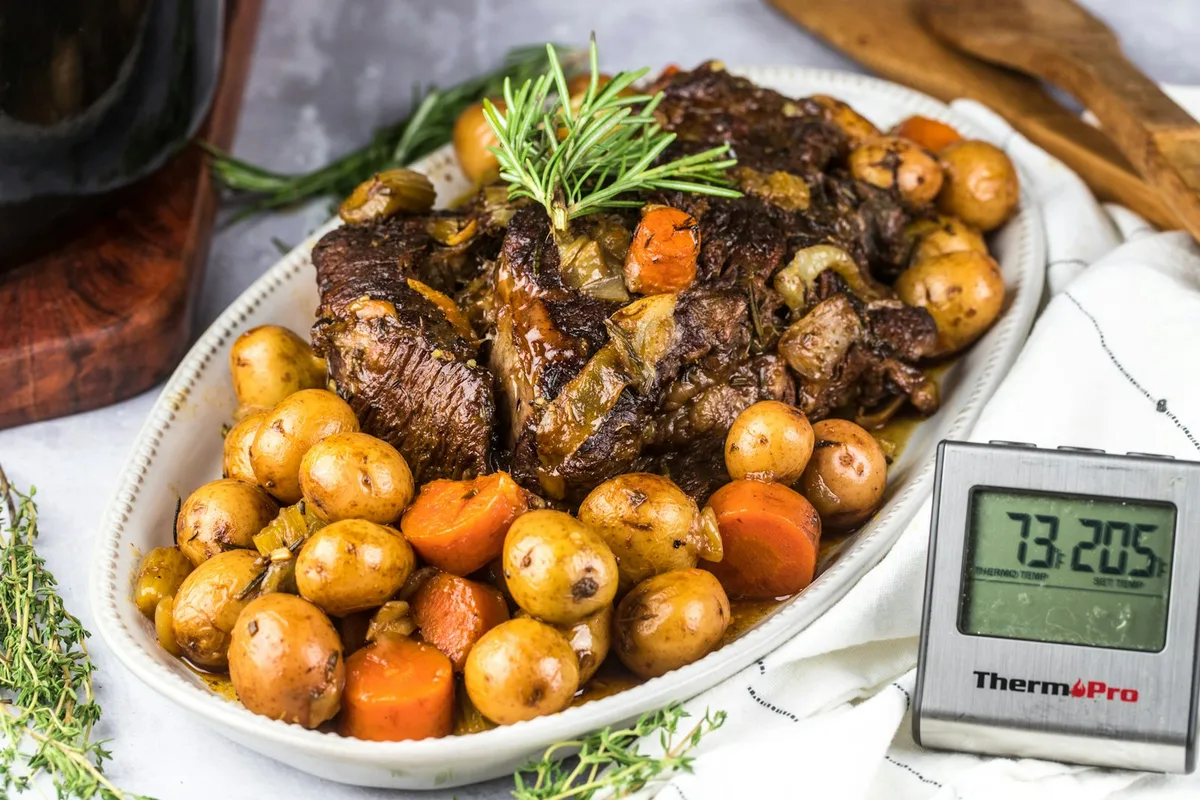
TL;DR: A 3 to 4 lb chuck roast runs 8 to 10 hours on LOW or 5 to 6 hours on HIGH in a slow cooker, or 60 to 75 minutes at high pressure in an Instant Pot with natural release. Chicken breasts take 8 minutes at pressure, dried beans 25 to 40 minutes. All poultry hits 165F internal, no exceptions. Slow cooker liquid roughly doubles what you need in the pressure cooker.
I own a Crock-Pot 7-quart oval and an Instant Pot Duo 6-quart, and I've burned dinner in both. So this is the chart I keep taped inside my cabinet door, built from years of ruined roasts and beans that stayed like gravel. It gives you hard numbers for both machines and the safe internal temps that actually matter.
Here is the thing nobody tells you when you buy either one. The recipe times online are guesses. Your cut of meat, your machine's wattage, and how full the pot is move the real number more than any recipe does. What you want is a starting range and a thermometer, not a stopwatch you trust blindly.
What are the slow cooker cook times for common dishes?
These assume the slow cooker is filled between half and two thirds full, which is where these machines cook safely and evenly. Times are for a standard 6 or 7-quart oval. A smaller round crock runs a touch faster.
| Dish | LOW | HIGH | Done when |
|---|---|---|---|
| Chuck roast, 3-4 lb | 8-10 hr | 5-6 hr | Shreds with a fork, 195F+ |
| Pulled pork shoulder, 4-5 lb | 9-11 hr | 6-7 hr | Pulls apart, 200F |
| Whole chicken, 4-5 lb | 6-7 hr | 3-4 hr | 165F in the thigh |
| Boneless chicken breast | 4-5 hr | 2-3 hr | 165F, still juicy |
| Bone-in chicken thighs | 5-6 hr | 3-4 hr | 165F, ideally 175F+ |
| Dried beans, soaked | 6-8 hr | 3-4 hr | Tender to the bite |
| Chili with browned beef | 6-8 hr | 3-4 hr | Flavors married, thick |
| Vegetable or bean soup | 6-8 hr | 3-4 hr | Vegetables soft |
| Beef stew | 7-8 hr | 4-5 hr | Beef fork-tender |
Notice that lean chicken breast is the one thing you can overcook here. Leave it on LOW for nine hours and you get dry, stringy meat. Pull it at 165F and stop. Fatty cuts like pork shoulder and chuck are the opposite. They shrug off an extra hour because there is collagen breaking down the whole time, and that is what makes pulled pork pull.
One habit that saved me a lot of grief: brown the meat in a skillet before it goes in. A slow cooker will never give you a seared crust, and that browning is where half the flavor of a stew lives. Fifteen minutes up front pays off in the bowl.
What are the Instant Pot cook times for the same dishes?
Every number below is minutes at high pressure, not total time. Add 10 to 20 minutes for the pot to come up to pressure, plus release time. My Instant Pot Duo takes about 12 minutes to pressurize a full pot, and a beginner's biggest shock is realizing the cook time on the recipe is not the time you actually wait.
Natural release means you let the pressure drop on its own, which can take 10 to 25 minutes and keeps meat tender. Quick release means you flip the valve and vent the steam fast, which you want for vegetables and delicate things that would overcook while sitting.
| Dish | Pressure minutes | Release | Notes |
|---|---|---|---|
| Chuck roast, cut in 3 chunks | 60-75 min | Natural 15 min | 1 cup liquid minimum |
| Pulled pork, 2-inch cubes | 60-75 min | Natural 15 min | Cube it for even cooking |
| Whole chicken, 4 lb | 25-30 min | Natural 10 min | On the trivet, 165F |
| Boneless chicken breast | 8 min | Natural 5 min | Fresh; frozen add 3-4 min |
| Bone-in chicken thighs | 12-15 min | Natural 10 min | Dark meat forgives longer |
| Dried beans, unsoaked | 25-40 min | Natural full | Kidney/black high end |
| Chili with browned beef | 15-20 min | Natural 10 min | Saute meat first |
| Vegetable or bean soup | 8-12 min | Quick | Beans already cooked |
| Beef stew | 35 min | Natural 10 min | Potatoes stay whole |
Dried beans are where the Instant Pot earns its counter space. No overnight soak, no watching a pot, and you go from a bag of hard beans to dinner in under an hour. Ever tried cooking dried chickpeas on the stove? It is a two-hour babysitting job. In the pressure cooker it is 35 minutes and a natural release.
If you cook a lot of chicken and rice, the pressure cooker handles both together beautifully. My one-pot chicken and rice is built around exactly that, and it is a weeknight staple in my house.
How do you convert between a slow cooker and an Instant Pot?
This is the question I get most, and the rules are rougher than people want them to be. Cooking is not that precise. Still, these get you close on the first try.
Going from slow cooker to Instant Pot:
- Cut the liquid by about half. A sealed pot barely loses moisture, so a stew that needed three cups on LOW might need one and a half. Never drop below one cup, or the pot cannot build pressure.
- For timing, 8 hours on LOW or 4 hours on HIGH becomes roughly 25 to 35 minutes at high pressure for most braises and soups. Big, dense roasts need more, up to 75 minutes.
- Brown meat on the Saute function first, then pressure cook. You lose the slow cooker's long, gentle simmer, so the sear matters more.
- Use natural release for anything with meat or beans so the fibers stay tender.
Going from Instant Pot to slow cooker:
- Add liquid back. The slow cooker evaporates over hours, so bump the pressure-cooker amount up by a cup or so.
- Multiply pressure minutes into hours. A 30-minute braise becomes 6 to 8 hours on LOW or 3 to 4 on HIGH.
- Skip the release rules entirely. There is no pressure to release.
Honestly, most braises, stews, chilis, and pulled meats convert cleanly. The dishes that fight you are the ones with a mix of quick and slow ingredients, like a soup where you want the beans soft but the greens fresh. Those are worth cooking in the machine the recipe was written for.
What internal temperatures are safe?
This is the part I refuse to shrug about, because it is the difference between dinner and a bad night. The USDA sets safe minimum internal temperatures, and a slow cooker's low heat makes them easy to miss if you cook by the clock instead of a thermometer. Here are the ones you use most, straight from the USDA safe temperature chart.
| Food | Safe minimum internal temp |
|---|---|
| All poultry (whole, pieces, ground) | 165F |
| Ground beef, pork, lamb | 160F |
| Beef, pork, lamb roasts and chops | 145F, rest 3 min |
| Beans and leftovers reheated | 165F |
Braised cuts like chuck and pork shoulder are a special case. They are safe at 145F, but they do not become tender and shreddable until 195F to 205F, when the collagen finally melts. So you cook them well past the safety line on purpose, for texture.
The slow cooker has its own safety rules, and FoodSafety.gov spells them out. Fill the crock between half and two thirds full, because too little food overcooks and too much heats too slowly. Never cook frozen meat in a slow cooker, since it lingers too long in the 40F to 140F danger zone where bacteria thrive. And if you can spare it, run the machine on HIGH for the first hour to get the food out of that zone quickly before dropping to LOW. Thaw meat in the fridge, not on the counter.
Slow cooker and Instant Pot troubleshooting
A few problems come up again and again, so here are the fixes that work in my kitchen.
Meat came out dry or tough. In a slow cooker this almost always means you used a lean cut or pulled it too early. Lean cuts have nothing to break down. Fatty cuts need more time, not less, so give a stubborn roast another hour before you give up.
The Instant Pot flashes "Burn." Something scorched on the bottom. Usually a thick sauce or too little liquid. Deglaze the pot after sauteing so no browned bits stick, keep at least a cup of thin liquid on the bottom, and layer thick tomato sauces on top without stirring them in.
Beans are still hard. Old beans that have sat in the pantry for a year can refuse to soften no matter what. Buy beans from a store with turnover, and add salt only after they are tender, not before, since salt in the cooking water can toughen the skins.
Soup or chili came out watery. The slow cooker traps steam that would have evaporated on the stove. Take the lid off for the last 30 to 45 minutes on HIGH, or stir in a slurry of a tablespoon of cornstarch mixed with cold water.
Everything tastes flat. Low, slow, moist heat dulls seasoning, so taste and adjust salt and acid at the end. A squeeze of lemon or a splash of vinegar wakes up a whole pot. If you want more ideas for cooking ahead in batches, my easy meal prep ideas lean hard on both these machines. And when I want fast, crisp weeknight food instead, my air fryer cook times chart is the other page taped inside my cabinet.
Both machines are worth owning. The slow cooker is the one I reach for when I want dinner waiting after a long day and a wide window to get home. The Instant Pot is the one I reach for when I forgot to plan and it is already 6 p.m. Learn the numbers for the food you actually cook, write your own in the margin, and you will stop guessing.