
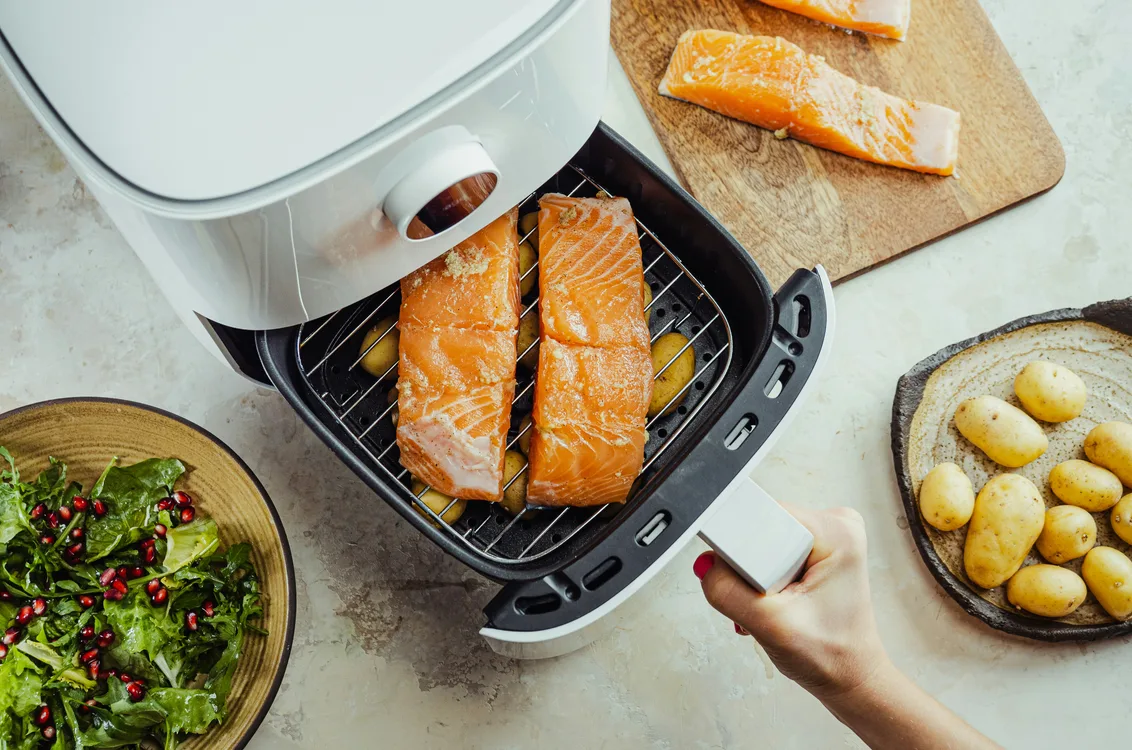
TL;DR: Most air fryer food lands between 350F and 400F. Thin frozen fries run 12 to 15 minutes at 400F, boneless chicken breast 16 to 20 minutes at 375F, a 6 oz salmon fillet 7 to 10 minutes at 390F, and bacon 8 to 10 minutes at 350F. Every number is a starting range, because wattage, load, and thickness move cook time more than any preset button does.
Every air fryer comes with a page of preset buttons, and they deserve less trust than the manual gives them. A preset is just a stored time and temperature pair. It doesn't know whether you loaded six wings or sixteen, whether they're fresh or frozen, or whether your machine pushes 1200 watts or 1750.
So this is a chart built to be cooked from. Start at the low end of each range, check early, and write your own numbers in the margin. That last part isn't a joke. The food you cook weekly deserves its own line.
The air fryer cook times chart
Times assume a preheated basket, food in a single layer, and a machine somewhere in the 1,300 to 1,750 watt range. Crowd the basket and everything below runs long.
| Food | Temp | Time | Flip or shake | Done when |
|---|---|---|---|---|
| Fresh-cut fries (soaked, dried) | 400F | 15-20 min | Shake every 5-6 min | Deep golden, crisp edges |
| Frozen fries, thin | 400F | 12-15 min | Shake halfway | Golden, no pale patches |
| Frozen fries, thick or crinkle | 400F | 15-20 min | Shake halfway | Golden, crisp shell |
| Chicken breast, boneless | 375F | 16-20 min | Flip halfway | 165F internal |
| Chicken thighs, bone-in | 380F | 22-25 min | Flip halfway | 165F minimum, better at 175F+ |
| Chicken wings | 380F | 20-24 min, then 400F for 3-5 | Flip twice | 165F internal, skin blistered |
| Salmon fillet, 6 oz | 390F | 7-10 min | No flip | 145F, flakes with a fork |
| Bacon, regular cut | 350F | 8-10 min | No flip | Crisp; thick cut runs 10-12 |
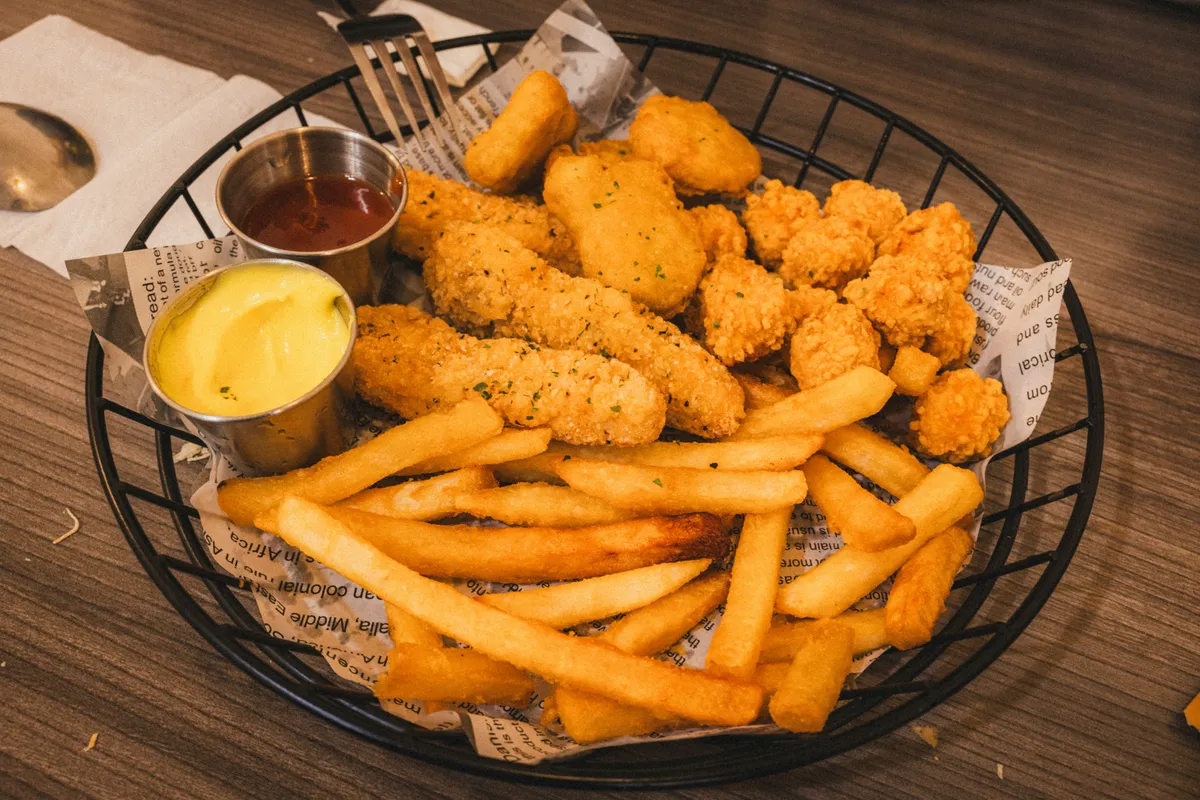
| Frozen nuggets or tenders | 400F | 10-12 min | Shake halfway | 165F internal, coating crisp |
| Frozen mozzarella sticks | 360F | 6-8 min | Turn once | Golden, before cheese escapes |
| Broccoli florets | 400F | 8-12 min | Shake once | Charred tips, tender stems |
| Brussels sprouts, halved | 375F | 12-15 min | Shake twice | Browned cut sides |
Converting an oven recipe instead? Drop the temperature by about 25F and start checking at three quarters of the stated time. It's a rough rule, not physics, but it lands close often enough that it's the first thing to try before hunting for a dedicated air fryer version.
Why 350F for bacon when most charts say 400F? Rendered bacon fat smokes right around 400F, and a smoking drawer sets off more smoke alarms than it crisps strips. Lower and slower gets you flat, even bacon without the haze. If you're feeding a crowd, the oven still wins on volume, and the method is laid out in our guide to bacon in the oven.
How long should you preheat, and for what?
Preheating isn't one rule for everything. It's the difference between crisp and limp on some foods and irrelevant on others, so it's better not to treat it as a checkbox.
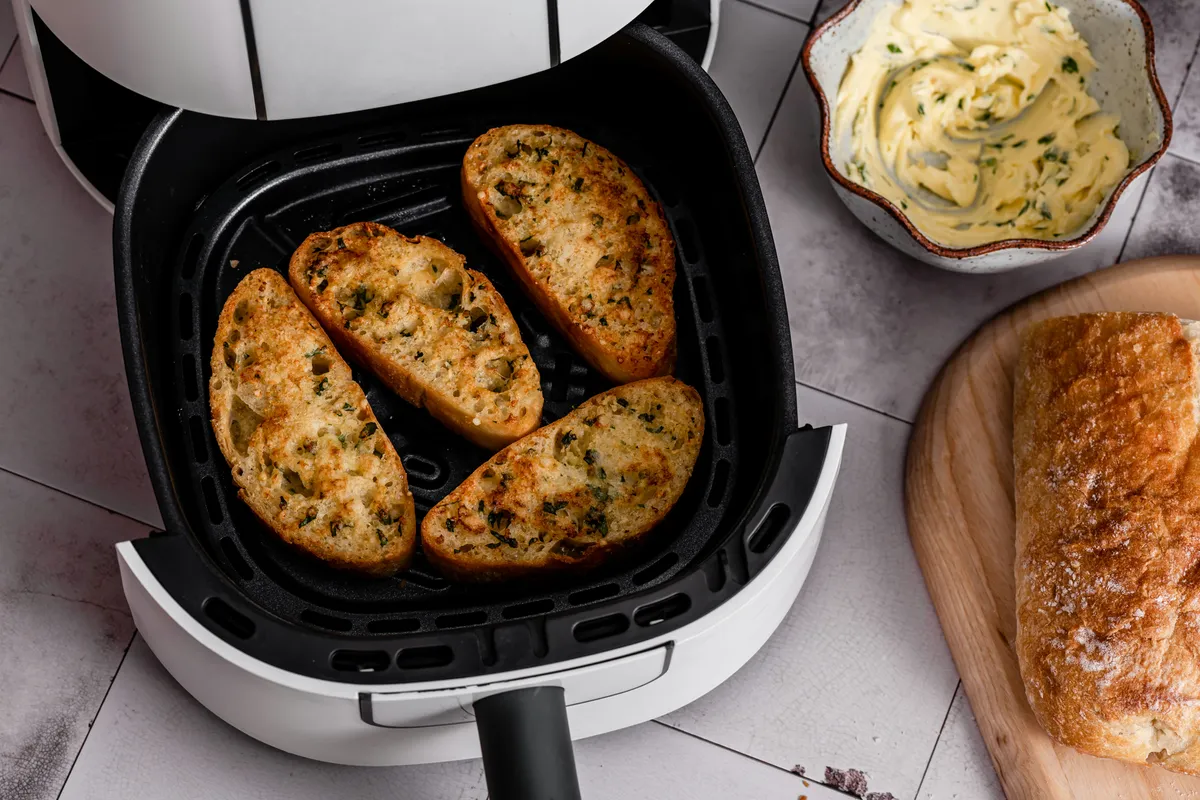
Anything you want crunchy wants a hot basket to start: fries, wings, bacon, breaded frozen stuff, halloumi. Three to five minutes at the cooking temperature gets the metal hot enough that browning starts the second food lands, instead of the food warming up slowly alongside the basket. A cold start on wings gives you rubbery skin that never fully crisps, however long you run it.
What can skip it? Anything cooked through rather than crisped. A salmon fillet, a tray of Brussels sprouts you're fine having soft, reheating last night's leftovers. Skip it there, because the two-minute wait buys nothing.
Wattage sets the wait: a compact 1,300 watt machine takes roughly 3 minutes to reach temperature, and a 1,750 watt one gets there in about 2. If your model has no preheat button, run it empty at your target temp for 3 minutes, then load it. Skipping the preheat entirely? Add 2 to 3 minutes to every time in the chart and expect softer edges.
What internal temperatures are non-negotiable?
Cook times flex. Internal temperatures don't. The US Department of Agriculture (USDA) puts poultry of any kind at 165F, fish at 145F, beef and pork steaks or chops at 145F followed by a 3 minute rest, and anything ground, from burgers to sausage out of the casing, at 160F.
Those numbers come straight from the USDA safe minimum temperature chart, published by its Food Safety and Inspection Service (FSIS), and they're the reason a $15 instant-read thermometer matters more than any accessory in the box. Chops are worth pulling at 140F and letting carryover heat finish the job, which is exactly how our air fryer pork chops stay juicy.
Air fryers brown fast. That's their whole trick. But browned outside says nothing about the middle of a thick chicken breast, so probe the thickest part and believe the number, not the color. Thighs are the one cut worth deliberately overshooting, to 175F or 180F, because the connective tissue that makes them chewy at 165F melts into something much better twenty degrees later. The same logic drives the oven method for crispy chicken thighs.
How do dual-basket models change the timing?
Two-basket machines don't change any temperature in the chart. They change how you coordinate two foods that finish at different minutes, and that's worth the counter space for anyone cooking a main and a side together.
The Ninja DoubleStack XL (SL401) stacks two 5-quart baskets vertically for 10 quarts total, and its meal racks let you split each basket, so four foods can run at once. The Cosori TwinFry (CAF-TF901-KUS) takes the opposite approach: one wide 9-quart drawer with a removable divider that splits it into two 4.5-quart zones, or opens up for a whole chicken. It draws 1,750 watts and runs from 95F to 465F.
Both machines put the same two buttons on the panel:
| Feature | What it does | When to press it |
|---|---|---|
| Match | Copies one basket's time and temp to the other | Doubling a batch of the same food |
| Sync | Staggers the start so both baskets finish together | Fries at 400F next to salmon at 390F |
Sync is the one that earns its keep. Without it you're doing restaurant math in your head, counting backwards from dinner. With it, the wings and the sprouts land at the same minute and nothing sits getting soggy.
Which pairs can share one Match setting, and which genuinely need Sync? The dual basket times and temps chart runs sixteen foods through exactly that question, because the answer isn't obvious until salmon is done and the sprouts beside it are still raw.
One honest caveat: splitting one heating system across two zones means a fully loaded machine has more total food fighting for the same hot air. Check doneness a couple of minutes early the first time you run both baskets full, then trust your notes. If you're still shopping, our ranked air fryers under $100 test covers the single-basket field these dual models are replacing.
Does wattage matter more than the preset button?
Here's the opinion part: preset buttons are decoration. Wattage and basket load decide your cook time, and neither one is something a stored program can see.
Wattage. A compact 4-quart machine drawing around 1300 watts and a TwinFry drawing 1750 watts will not cook the same fries in the same minutes. More watts means faster heat recovery every time you open the drawer to shake. If your food consistently finishes 3-4 minutes before the ranges here, you own a strong machine. Consistently after? Underpowered, or overfilled.
Load. Air frying is just violent convection, and hot air needs a path around every piece. Sound familiar, that batch of fries that came out half crisp and half steamed? That's a double layer blocking airflow, not a bad recipe. Doubling the food doesn't double the time, but it adds real minutes and costs you crust. Two smaller batches beat one crammed one, every single time.
The presets can't see any of this. The chart plus a thermometer can.
How to make the chart yours
Cook your top three foods once each this week, note where your machine landed inside the ranges, and you'll never look up air fryer times again. Expect your machine to drift somewhere in the ranges, fast on some foods and slow on others, which is exactly why the notes are worth keeping.
If wings are on that list, start with the plain chart entry above, then graduate to the Korean fried chicken wings, which use the same two-stage temperature trick with a glaze that actually deserves it.