
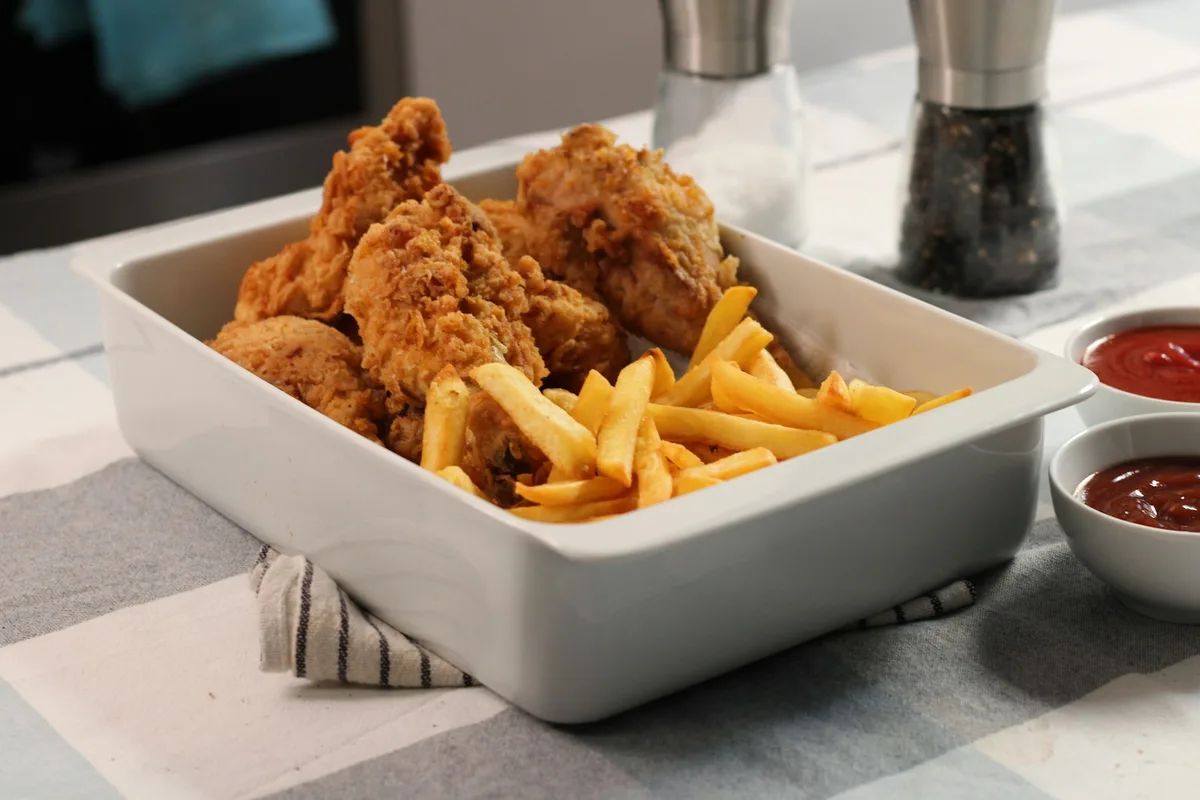
TL;DR: A dual basket doesn't cook anything faster. It cooks two things at once and, if you use the sync button instead of the timer in your head, it makes them arrive together. Most foods land between 350F and 400F. Wings run 400F for 22 to 26 minutes, boneless chicken breast 375F for 16 to 20, salmon 390F for 8 to 10, bacon 350F for 8 to 10.
I bought a two-basket machine for the wrong reason. Speed, I assumed. It isn't faster, and anyone selling it that way is selling you the wrong feature. So what does the second drawer actually buy you?
What it fixes is arrival. One basket of wings and one of brussels sprouts used to mean the sprouts sat under foil going limp for eleven minutes while the wings caught up, and the whole plate arrived slightly worse than either dish deserved. So the chart below isn't a list of cook times. It's a list of cook times with the second basket already accounted for.
The dual basket time and temperature chart
Every row assumes a preheated basket, a genuine single layer, one basket running, and a machine in the 1,500 to 1,750 watt range. These are compiled from the Ninja DualZone and Cosori TwinFry manuals plus my own kitchen notes, and they're starting points rather than laboratory numbers. Running both drawers at once changes them, which is the whole subject of the mistakes section further down. I have not measured your air fryer. Nobody has.
| Food | Temp | Time | Dual-basket note |
|---|---|---|---|
| Frozen fries, thin | 400F | 15-18 min | 400F group; Match Cook with wings or nuggets |
| Fresh-cut fries | 400F | 18-22 min | The long pole; start this basket first |
| Chicken wings | 400F | 22-26 min | Flip at 12; usually the anchor food |
| Frozen nuggets | 400F | 10-12 min | Start 12 min into a wings run |
| Boneless chicken breast | 375F | 16-20 min | 375F group; pairs with sprouts on Match |
| Bone-in chicken thighs | 380F | 22-26 min | Anchor food; sides go in late |
| Salmon fillet, 6 oz | 390F | 8-10 min | Needs sync, not Match; very short |
| Shrimp, large | 400F | 6-8 min | Shortest on the chart; start last |
| Bacon | 350F | 8-10 min | 350F on its own; never Match with fries |
| Steak, 1 inch | 400F | 10-14 min | Rest 5 min; start 10 min after fries |
| Pork chops, 1 inch | 380F | 12-14 min | Pairs with potatoes on sync |
| Tofu cubes, pressed | 375F | 15-18 min | 375F group; forgiving partner |
| Brussels sprouts, halved | 375F | 14-16 min | Match Cook with chicken breast |
| Broccoli florets | 375F | 8-10 min | Start 8 min into a chicken breast run |
| Baby potatoes, halved | 400F | 18-22 min | Long side; treat as a second anchor |
| Frozen mozzarella sticks | 380F | 6-8 min | Start last; collapses if overcooked |
Match Cook and sync finish are not the same button
People press these interchangeably and then wonder why dinner went sideways. They solve opposite problems.
Match Cook copies, it does not coordinate
Match Cook mirrors one drawer's temperature and time onto the other. That's the whole function. It's for the night you're cooking three pounds of wings and one basket won't hold them, and it's useless the moment your two foods want different numbers.
Here's my unpopular position: Match Cook is the button most owners press most and need least. It saves you roughly four seconds of pressing. Meanwhile the feature that justifies the appliance sits unused two inches to the left.
Sync finish does the arithmetic you'd otherwise do badly
Set basket one to wings at 400F for 24 minutes. Set basket two to broccoli at 375F for 9. Press sync, and the machine holds the broccoli for fifteen minutes before starting it, so both drawers stop at the same second. Ninja calls this Smart Finish on its DualZone models, including the DZ302 and the DZ401, both 1,690-watt 10-quart machines that split into two 5-quart drawers. Cosori calls its version Sync on the 1,500-watt TwinFry, which is one wide 9-quart drawer divided into two zones rather than two separate baskets. Watch the model number when you shop: Cosori's older 9-quart dual basket runs 1,750 watts and labels the same two functions Sync Cook and Sync Finish, so half the advice you'll read online is describing a different machine than the one in the photo.
Could you do this with a phone timer? Sure. I did for months. But you have to be standing there at minute fifteen, and the one night you aren't is the night the broccoli is raw.
A dual basket doesn't cook faster. It just stops one half of dinner going cold while the other half finishes.
The temperatures that aren't up for debate
Times in that chart are suggestions. Internal temperature isn't, and a two-basket machine gives you two chances a night to get it wrong. These are the USDA safe minimums, copied from the chart rather than remembered:
- Poultry, every cut and every form: 165F
- Ground beef and ground pork: 160F
- Ground poultry: 165F
- Pork chops and roasts: 145F, then a 3-minute rest
- Beef steaks and roasts: 145F, then a 3-minute rest
- Fish and shellfish: 145F
Probe the thick part, not the edge. And which drawer should you check first? The one that finished second, every time, because that's the one your machine short-changed on airflow while the other basket was hogging the fan.
Three mistakes that wreck a two-basket dinner
Pairing across a 50-degree gap. Bacon at 350F opposite fries at 400F is fine on independent zones and impossible on a divided single drawer. Know which machine you own before you plan the menu. My air fryer cook times chart covers the single-basket side of this.
Loading by volume instead of by layer. Two drawers tempt you to fill both, and a bag of sprouts looks so reasonable tipped into an empty basket. Don't. A double layer steams, and steamed sprouts next to crisp wings is a worse plate than either food cooked alone. Ever pulled out a drawer where half the batch was browned and half was pale and wet? That's airflow, not seasoning, and no amount of extra minutes fixes it.
Using single-basket times when both drawers are running. This is the one that catches everybody, and it's in Ninja's own printed chart if you read the columns properly: there's a time for cooking in one zone and a longer time for cooking in both. A pound of frozen fries is 18 to 22 minutes alone and 28 to 32 with the second drawer working. Ninja's manual says each zone has its own heating element and fan, so why the gap? Because the whole appliance draws 1,690 watts on one 15-amp circuit no matter how many drawers you fill, and that budget gets split. Separate elements, shared power. Add roughly a third to any single-basket time you've been using, then check with a thermometer rather than the clock. That shared budget is also why running both baskets costs about what running one does, a point I worked through in detail on what the TwinFry costs to run.
Make it yours in one week
Pick your three regular dinners. Cook each once with sync engaged, note where your machine landed inside my ranges, and write it on the lid in marker if that's what it takes. Mine runs fast on vegetables and slow on bone-in chicken. Yours will drift somewhere else, and after three sessions you'll stop looking anything up.
Start with wings, because they're the most common anchor food and the most forgiving. Once the timing clicks, my Korean fried chicken wings use the same two-stage heat with a glaze worth the extra step.